
Affirm: Buy now, pay over time
Affirm, IncShopping
4.8228.55K Reviews
- Version
- 4.109.2
- Installs
- 10.00M
- Age Rating
- Everyone
Screenshots
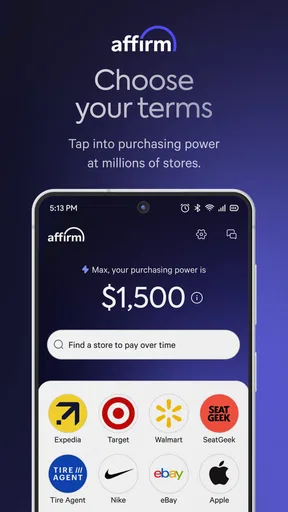
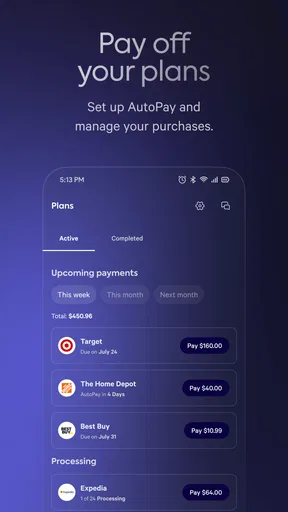
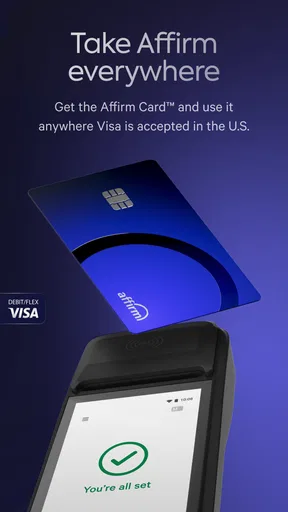
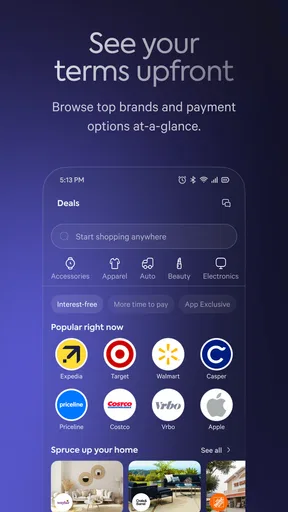
Our Review of Affirm: Buy now, pay over time
 Analysis by Appyee
I spent time using Affirm: Buy now, pay over time as a shopping companion rather than treating it like a simple checkout shortcut. My impression is that it is most useful when I already know what I want to buy and need a clearer way to think about the payment schedule. It is less compelling when I am browsing without a budget, because the convenience of splitting a purchase can make an expensive item feel easier than it really is.
Affirm is a free shopping app from Affirm, Inc, designed for flexible payments and savings. It has an Everyone content rating, so its presentation is accessible to a broad audience, while the actual suitability of a purchase still depends on the person using it and the terms shown for that transaction. The app has built a large audience, with a 4.8 average from around 565 thousand ratings and more than 10 million installs.
How Affirm feels during everyday shopping
I find Affirm most useful when I approach a purchase with a clear budget and treat the payment details as something to inspect, not a reason to spend more. In this section, I’ll focus on how that mindset shapes an everyday shopping session and where a deliberate pause can make the app more helpful.
Fast enough when I have a clear task
The app makes the most sense in a focused shopping session. If I am checking an item, comparing the total with a payment option, or reviewing an existing purchase, I expect the experience to feel more direct than opening a retailer’s website and trying to understand a financing choice at the last moment. The interface is centered on a practical question: what will this purchase look like over time?
That focus helps the app feel approachable. I do not need to treat it as a full marketplace or a general budgeting tool. I see it as a layer between shopping and payment planning. When I use it with that expectation, the flow feels easier to understand than a conventional credit-card statement, especially for someone who wants to consider the schedule before committing.
Speed is also affected by the task itself. Looking at an offer or checking a purchase is naturally quicker than making a decision about a large item. The app can present payment information efficiently, but it cannot remove the time needed to read the terms and decide whether the purchase fits my budget. The fastest experience is not always the safest decision, and that distinction matters here.
What happens when I use it for a larger purchase
A realistic example would be replacing a necessary household item after the old one stops working. I might find the product through a participating retailer, open the payment option, and use Affirm to examine the available schedule before finishing the order. In that situation, the app is valuable because it gives me a moment to pause and compare the recurring obligation with my other bills.
I would not use that moment merely to ask whether the payment looks small. I would check the full amount, the timing of each payment, and whether the arrangement leaves enough room for essentials. A split payment can improve short-term flexibility, but it still represents a commitment. The app helps me inspect that commitment; it does not make the item cheaper simply because the cost is divided.
This is one of the less obvious strengths of the service: it can turn a rushed checkout decision into a planning step. The benefit is greatest when I use it before I am emotionally attached to the purchase. If I wait until I am already determined to buy, I am more likely to treat the payment view as permission rather than information.
Heavy-use moments and the points where friction appears
Affirm is not demanding in the same way as a game or a video editor. My heavier use would come from comparing several purchases, reviewing multiple payment obligations, or moving between shopping and account information in one session. Those moments test organization more than raw performance. I want the app to keep the details easy to distinguish so that I do not confuse one purchase with another.
For that reason, I would approach a busy shopping period carefully. If I am buying several items close together, I would record the total commitments somewhere outside the app as well, such as in my household budget. That is not because the app is unsuitable for multiple purchases; it is because a payment service should not become the only place where I understand my monthly obligations.
Another practical trade-off is attention. Flexible-payment apps can make it easier to focus on the immediate amount rather than the complete cost. I found the most responsible workflow was to decide on a maximum spending limit first, then use the app to see whether the payment arrangement fits inside it. Reversing those steps can encourage me to shop up to the payment amount instead of shopping within my means.
For occasional use, that extra discipline is manageable. For frequent shoppers, it becomes essential. The app is better suited to people who will treat each plan as a financial commitment, not as a general-purpose way to stretch every purchase.
Reliability is more than opening the app
In a payment app, reliability means more than a screen appearing quickly. I also need confidence that I am looking at the right purchase, the right schedule, and the right account information before acting. My review of Affirm therefore centers on clarity and recovery as much as on speed. A smooth interface is helpful, but careful confirmation is the real safeguard.
If I am interrupted during shopping, I would restart by checking the purchase details rather than assuming I am still at the same step. That small habit matters on any financial workflow. It is especially useful when switching between a retailer and the payment app, because the shopping context can change while I am away from the screen.
The app’s popularity gives me some reassurance that it is not an obscure experiment. Affirm has around 222 thousand written reviews and a strong average rating, which suggests that many people have formed a positive view of the overall experience. I still would not treat popularity as proof that every transaction will be effortless. Payment decisions are personal, and a service can be convenient while still requiring close attention.
Recovery is also about what I do after a disrupted session. If the app closes, the connection changes, or I simply lose track of where I was, I would avoid repeating a purchase immediately. I would reopen the app, review the current information, and confirm whether anything was actually submitted. That workflow may feel slower, but it is preferable to creating confusion through repeated taps.
Device constraints and practical expectations
Affirm requires a device running operating system version 10 or later. That is an important check before downloading, particularly if I keep an older phone for banking and shopping. A device that falls below the requirement is not a good candidate for this app, even if it still handles basic browsing comfortably.
On a compatible phone, I would expect ordinary shopping tasks to be more manageable than resource-heavy entertainment apps. The app’s purpose does not call for intensive graphics or long media sessions. That makes it a reasonable fit for a phone used mainly for purchases, account checks, and occasional payment planning. Still, I would keep the operating system updated when possible, because payment information deserves a current and well-maintained device environment.
Storage and battery are not the main reasons I would reject this app. The more meaningful constraint is behavioral: I need enough screen space and concentration to read payment details without rushing. A small or aging phone may technically run the application while making comparison and confirmation less comfortable. In that case, a retailer’s larger web checkout or a computer may be easier for a careful review.
I would also avoid making a purchase while distracted, travelling between weak connections, or handing the phone to someone else. Those are not special defects of Affirm; they are situations where any payment workflow becomes harder to verify. The app is most dependable when I use it in a calm setting and confirm each important step myself.
Where it beats ordinary alternatives
The usual alternatives are a debit card, a credit card, a retailer’s own financing option, or simply waiting until I can pay in full. Affirm’s advantage is that it places payment flexibility directly into the shopping decision. Instead of treating the payment method as an afterthought, I can consider the schedule alongside the item.
That can be more transparent than mentally translating a credit-card purchase into a future balance. It may also be more convenient than managing a retailer-specific account for every store. For someone who shops across different retailers and wants one familiar payment experience, the app has a clear role.
However, a traditional debit card is better when I want the purchase to leave my account immediately and avoid another future obligation. A credit card may be preferable for someone who already has a disciplined repayment system and values the protections or rewards attached to that card. Paying in full is usually the simplest option when it is comfortably affordable. Affirm is not automatically superior; it is useful because it solves a particular cash-flow problem.
I would also compare the complete cost rather than choosing based on the smallest recurring amount. A retailer’s direct offer may suit a particular purchase better, while a bank product may fit an established budget more naturally. The right choice depends on the item, the schedule presented, and my ability to manage the commitment without relying on another future payment plan.
Who will get the most from the app
I think Affirm is a good match for shoppers who want to slow down at checkout and understand how a purchase could be divided over time. It is especially practical for someone replacing a necessary item, planning a significant purchase, or trying to separate a one-time expense from the rest of the month without losing sight of the total.
It can also help people who dislike the uncertainty of seeing a purchase on a general credit-card balance. The dedicated payment view gives the commitment a distinct place in my thinking. That separation can make budgeting easier, provided I still include it in the same overall household plan.
The app is less suitable for anyone who tends to buy impulsively when a recurring amount looks manageable. I would also suggest skipping it if the purchase is already difficult to afford in full, if several existing obligations are competing for the same income, or if the user does not intend to read the terms before confirming. In those situations, flexibility can add pressure rather than reduce it.
Someone who only wants occasional discounts may not find enough reason to install a dedicated payment app. Likewise, a shopper who already has a reliable system with a bank or credit card may prefer staying with that familiar option. Affirm earns its place when its payment planning is genuinely useful, not simply because it is available.
Version, cost, and the practical download decision
The app is free to download, and the current version is 4.89.1. That makes trying the shopping experience relatively straightforward, but free installation should not be confused with free borrowing or a guarantee that every purchase has the same terms. I would always review the details shown for the specific transaction before agreeing to anything.
The Everyone rating is helpful for general accessibility, but it does not replace financial judgment. A younger or inexperienced shopper may still need guidance from a parent or trusted adult when considering a payment commitment. The label describes the app’s audience suitability, not whether every purchase is a wise choice for every person.
Affirm was released on June 20, 2016, and its continued presence alongside a current version suggests an established product rather than a newly launched experiment. I value that maturity, but I still judge the app by the clarity of the experience in front of me. Older services can be dependable, yet familiar branding should never encourage me to skip a final review.
My performance verdict after using it
My overall view is positive, with a clear condition: Affirm works best as a deliberate payment-planning tool, not as a reason to purchase more. It feels focused for normal shopping tasks, does not appear aimed at resource-heavy phone use, and offers a more structured way to consider flexible payments than simply charging everything to a general card balance.
The main limitation is not a lack of speed. It is the possibility that convenience changes how I perceive affordability. The app can make a purchase easier to organize, but it cannot make an unnecessary expense necessary or remove the responsibility of meeting future payments. That is why my preferred workflow is to set a budget first, inspect the complete arrangement second, and confirm only after both the item and the commitment make sense.
If you want a free shopping app from Affirm, Inc that brings payment planning closer to the moment of purchase, I think it is worth considering. I would recommend it to a careful shopper who wants flexibility and is willing to track the result. I would point someone toward paying in full, using an existing card, or waiting instead if the split payment is the only reason the purchase feels possible. Used with that distinction in mind, Affirm: Buy now, pay over time is a useful convenience rather than a substitute for a budget.
Privacy and Permissions
See what permissions an app requests and how it handles your data.
- Location
- approximate location (network-based), precise location (GPS and network-based)
- Photos/Media/Files
- read the contents of your USB storage, modify or delete the contents of your USB storage
- Storage
- read the contents of your USB storage, modify or delete the contents of your USB storage
- Camera
- take pictures and videos
- Wi-Fi connection information
- view Wi-Fi connections
- Other
- view network connections, change network connectivity, expand/collapse status bar, full network access, run at startup, control vibration, prevent device from sleeping
Verdict
Strengths of Affirm: Buy now, pay over time
- Flexible payment plans can make larger purchases easier to manage.
- Clear repayment schedules help users understand upcoming installments.
- Available through many popular online and in-store retailers.
- Applying usually takes only a short time at checkout.
- Early repayment may be possible without a prepayment penalty.
Limitations of Affirm: Buy now, pay over time
- Approval and spending limits can vary based on your financial profile.
- Late payments may lead to fees or affect future account access.
- Not every purchase or merchant supports all payment options.
- Multiple installment plans can make monthly expenses harder to track.
- Some longer-term plans may include interest charges.
Similar Picks in This Category
View All
SHEIN-Shopping Online
Roadget Business PTE. LTD.4.8

Amazon Shopping
Amazon Mobile LLC4.4


Mercado Libre: Compras online
Mercado Libre4.8

Wish: Shop and Save
Wish US Holdings LLC4.7

Alibaba.com - B2B marketplace
Alibaba Mobile4.4
Frequently Asked Questions
What is Affirm: Buy now, pay over time?
Affirm is a financing app that lets eligible shoppers split the cost of purchases into scheduled payments instead of paying the full amount immediately. Depending on the retailer, purchase price, and your eligibility, you may see options such as biweekly or monthly payments. The app can also display your payment schedule, manage existing plans, and help you discover participating stores.
Does Affirm charge interest or additional fees?
Affirm may offer plans with 0% APR, but other purchases can have interest rates depending on factors such as the merchant, purchase amount, repayment term, and your credit profile. The exact APR and total repayment amount should be shown before you accept a plan. Affirm generally promotes no late fees, but users should still review the agreement carefully because payment terms and other conditions can vary.
Will using Affirm affect my credit score?
Applying for an Affirm payment option may involve a soft credit check, which typically does not affect your credit score. However, some financing products or circumstances may involve credit reporting, and an approved loan can potentially influence your credit history. Missing payments may also have consequences, depending on the product and reporting practices. Always read the disclosures presented during the application process.
Where can I use Affirm, and can I use it in physical stores?
Affirm is available at participating online and physical retailers, but acceptance is not universal. In the app, you can browse supported merchants and may receive a virtual card or other payment method for eligible purchases. Availability, spending limits, and checkout options can differ by retailer and user. Before shopping, confirm that the store and the specific purchase are supported.
What happens if I miss an Affirm payment or want to return an item?
You should keep enough money available for each scheduled payment and contact Affirm promptly if you expect a problem. Although late fees may not apply to many plans, missed payments can still affect your account or credit situation under the applicable agreement. If you return an item, the merchant usually must process the refund first; your Affirm balance may then be adjusted, but payments can remain due until the return is completed.
